Millionaire Quiz: Trivia Games
wolfkigWord
3.882.00 Reviews
- Version
- 1.1.63
- Installs
- 10.00M
- Age Rating
- Everyone
Screenshots
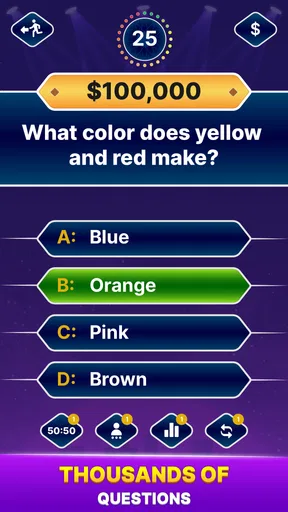
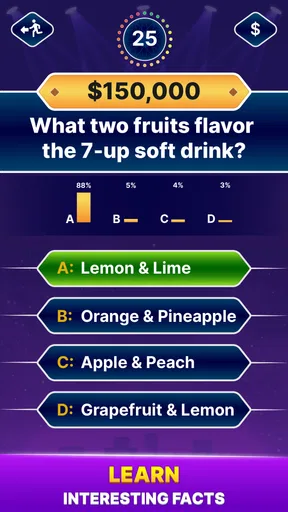
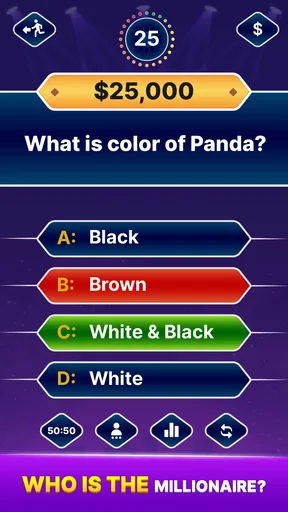
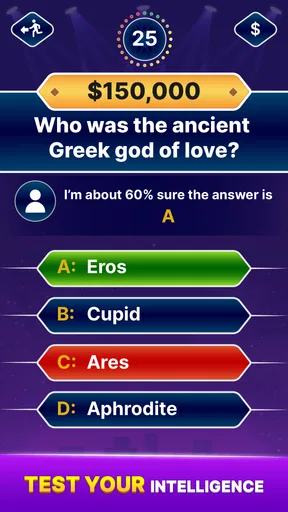
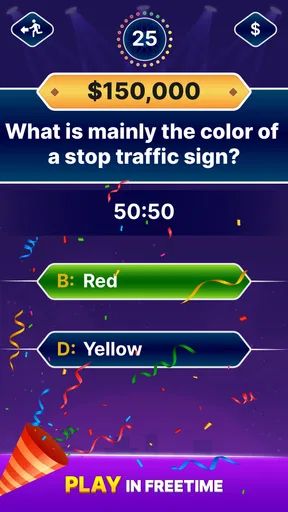
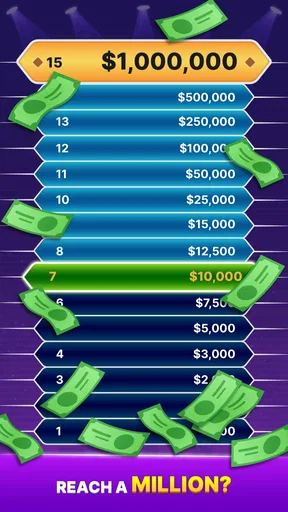
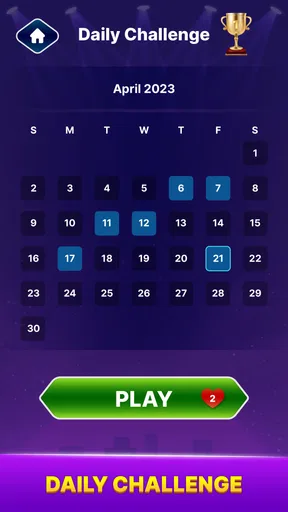
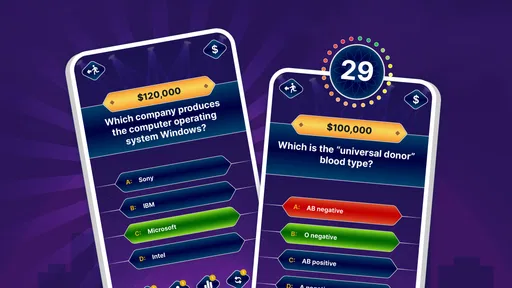
Our Review of Millionaire Quiz: Trivia Games
 Analysis by Appyee
I spent time with Millionaire Quiz: Trivia Games as a quick-fire word and knowledge game, and its main appeal became clear almost immediately: it turns general knowledge into a simple question-and-answer challenge with the feeling of working toward a big prize. The store summary talks about using your knowledge to become a millionaire, but in everyday use I found the more useful promise is smaller and more realistic. It gives you a compact way to test what you know, notice the subjects where you hesitate, and enjoy a few minutes of mental competition without needing to prepare first.
This is a free game from wolfkig, rated for Everyone, so it is easy to recommend as a casual family-friendly option. It has passed the ten-million-install mark and holds an average rating of 3.8 from roughly twelve thousand ratings, which suggests that plenty of players find the basic format approachable while also leaving room for some mixed experiences. I would not treat it as a serious study tool, but I can see its value as a light daily quiz, a conversation starter, or a way to fill an awkward wait.
Why the millionaire-style quiz format works
The strongest capability here is not simply asking trivia questions. It is the way the game gives ordinary knowledge a sense of progression. A question about vocabulary, history, science, geography, or everyday facts feels more engaging when I am answering it as part of a climb rather than reading isolated flashcards. That framing changes my behavior: I think a little longer before tapping, and I pay more attention to why an answer was right or wrong.
That distinction matters because many word games are built around spelling, anagrams, or finding words from a fixed group of letters. This one is better understood as a broad knowledge quiz with a word-game feel. If you want to build a word from tiles or solve a crossword, this is not a substitute. If you enjoy recognizing the correct answer under mild pressure, its format is much closer to a televised quiz show translated into a phone-friendly session.
I also like that the central idea is understandable without a tutorial-heavy introduction. The short description, “Millionaire Quiz,” tells you what kind of experience to expect, and the first questions are easy to approach even if you have not played this type of game recently. That simplicity is a genuine strength on a small screen. I can open it, read a question, choose an answer, and understand the result without learning a complicated control scheme.
The millionaire theme also creates a useful tension between confidence and caution. A question can look obvious until two answers seem plausible. In those moments, the game is testing judgment as much as memory. I found myself separating facts I actually knew from answers that merely sounded familiar. That is a modest but worthwhile mental habit, especially when playing with another person and explaining why a choice seems convincing.
How a short session feels in practice
In practice, I would use this game in short bursts rather than plan a long uninterrupted sitting. It suits the five-minute gap before an appointment, a quiet commute when I am not driving, or a relaxed evening when I want something more active than scrolling. The questions provide enough variety to make a session feel purposeful, but the format remains light enough that I do not need to reserve a large block of time.
My preferred way to play is to treat each question as a two-step decision. First, I answer from memory without overthinking. Then, if I am uncertain, I compare the wording and the possible answers carefully before committing. This makes the game more satisfying than tapping quickly. It also exposes a common weakness in quiz play: sometimes the problem is not a lack of knowledge but careless reading.
A useful routine is to remember the questions that caused hesitation instead of only celebrating correct answers. If I miss a question about a subject I normally enjoy, I mentally group it with similar topics. For example, a mistake in a geography question may remind me to slow down when place names look alike. The game does not need to become formal revision for this approach to help; the act of noticing patterns makes each round more valuable.
For parents or older siblings, the Everyone age rating makes it suitable for shared play, but I would still keep the tone relaxed. A child may know an answer an adult misses, and the reverse can happen just as often. Rather than turning the score into a judgment of intelligence, I would use the questions as prompts: why did one answer seem right, and what clue changed your mind? That makes the game more social and avoids making a wrong answer feel embarrassing.
Another practical tip is to play when you can give the question your full attention. Trivia games are easy to underestimate, yet interruptions make them frustrating because a missed answer may reflect distraction rather than knowledge. I would not open it while multitasking through work or watching a program that requires concentration. It works best as the main activity for a few minutes, not as background noise.
The best everyday scenario for this game
The clearest use case for me is a small group waiting together with nothing obvious to do. Imagine two friends sitting in a café before an appointment, or family members relaxing after dinner. One person can read the question aloud while everyone makes a choice, then the group can discuss the reasoning. The game supplies the structure, while the conversation supplies the personality that a solo quiz cannot provide.
This scenario also reveals a strength that is easy to miss in a store description: the game can turn uneven knowledge into shared entertainment. Someone who knows little about sport may be excellent with language, while another player may recognize historical details immediately. Because the subjects do not belong to one narrow specialty, every participant gets opportunities to contribute. I would choose it over a highly specialized quiz when the group has mixed interests.
It is also useful for a person who wants a low-pressure way to restart a reading or learning habit. I would not use it as the only source for studying, and I would check important facts elsewhere if accuracy mattered. Still, answering a few questions can make me curious enough to look up a topic afterward. That is where the game has its best educational effect: it creates a question in my mind, rather than pretending to replace a textbook.
For solo play, the best scenario is a short mental reset. After spending too long on repetitive social feeds, answering questions asks me to recall, compare, and decide. The change of pace is welcome. It is not an intense puzzle experience, but it is more mentally engaging than passively consuming another stream of content.
Where the experience asks for compromises
The biggest trade-off is that broad trivia is naturally uneven. A question that feels perfectly fair to one player may feel obscure to another, depending on age, education, language background, and personal interests. I would not judge the whole game by a single difficult question. At the same time, players who want consistently deep, specialist-level challenges may find a general quiz too shallow.
The format can also become repetitive for people who need constant novelty. The core action remains answering questions, so there is no elaborate world to explore or complex skill system to master. That is part of its accessibility, but it limits long-term variety. If I wanted word construction, a crossword, or a strategic puzzle, I would choose a dedicated game in that category instead of expecting this quiz to provide all three experiences.
Another limitation is the emotional effect of the prize framing. The millionaire idea makes progress feel exciting, but it can also encourage me to rush because I want to keep climbing. Rushing is usually a mistake in trivia. I get more enjoyment when I accept that losing a round is useful feedback rather than trying to protect an imaginary perfect run. Players who dislike score pressure may prefer a calmer knowledge app with flashcards or untimed practice.
The rating of 3.8 indicates that the game is not universally loved, and that is consistent with my view of its position. The concept is accessible, but the appeal depends heavily on question quality, pacing, and how much repetition an individual player tolerates. I would approach it as a free experiment rather than a guaranteed long-term favorite. Since it costs nothing to try, the sensible test is whether the first few sessions make you curious to continue.
Device compatibility is also worth checking before installing. The game requires Android 7.0 or later, so it is not aimed at every older Android phone. On a compatible device, the current version is 1.1.63. I would update when available through the normal store process, especially if an older installation behaves inconsistently, but I would not assume that a version number alone changes the fundamental quiz format.
Because it is free, I would also set expectations correctly. Free access makes it convenient for casual play, but it does not automatically mean the experience will match a premium word game with carefully curated progression or extensive offline learning tools. If your priority is a polished, distraction-free study environment, a dedicated educational app may be a better fit. If your priority is an easy quiz that you can try without paying first, this one has a clearer advantage.
Who will get the most from it
I think the best audience is someone who enjoys general knowledge but does not want a complicated game. You will probably appreciate it if you like answering questions in short sessions, comparing your instincts with friends, and learning which subjects make you hesitate. It is especially suitable for mixed groups because the broad topic range gives different people a chance to shine.
It can also work for a player who wants a gentle daily habit. My advice would be to create a simple rule: play one brief session, note one question that surprised you, and stop before the format starts to feel repetitive. That approach protects the game’s strongest quality, which is convenience. Trying to force a long marathon can turn a pleasant quiz into a tiring sequence of similar decisions.
I would skip it if you are looking for a serious vocabulary trainer, a competitive multiplayer system, or a deep puzzle campaign. I would also look elsewhere if you need guaranteed academic accuracy, detailed explanations for every answer, or a carefully organized course. Those needs call for specialized tools. This game is more successful as an accessible knowledge pastime than as a replacement for structured learning.
For younger players, the Everyone rating makes the subject matter broadly approachable, but shared play is still the best way to get more value from it. Adults can help explain unfamiliar references, and children can bring surprising recall of topics adults overlook. That exchange is more rewarding than simply watching a score rise.
There is a useful middle ground for casual learners, too. I would play it before researching a topic, not instead of researching it. When an answer sparks curiosity, write down the subject and explore it later through a reliable source. In that workflow, the game acts as a discovery tool. Its questions become starting points, while the deeper understanding comes from elsewhere.
My recommendation after using it
The real strength of Millionaire Quiz: Trivia Games is its ability to make ordinary recall feel like a small event. It does not need elaborate controls or a complicated premise to be enjoyable. The millionaire-style climb gives each answer a little weight, and the broad quiz format makes it easy to share with people whose interests are different from mine.
I would recommend it to anyone wanting a free, family-friendly word and trivia game for short sessions. I would approach it with moderate expectations about depth and replay value, because the same straightforward structure that makes it welcoming can eventually feel limited. Its average rating reflects that balance: appealing enough for a large audience, but not necessarily the perfect match for every quiz fan.
In the end, I see it as a convenient mental break rather than a complete learning platform. Downloading it makes sense if you enjoy testing your memory, discussing uncertain answers, and turning spare minutes into a small challenge. If you need advanced wordplay, specialist knowledge, or a structured study plan, choose a more focused alternative. For everyone else, wolfkig’s free quiz is worth trying once, then keeping only if the questions leave you wanting to find out more.
Verdict
Strengths of Millionaire Quiz: Trivia Games
- Covers varied topics, so each quiz round feels different.
- Short questions make it easy to play during quick breaks.
- Simple controls are suitable for casual players of all ages.
- Progression can encourage players to keep improving their scores.
- Useful for testing general knowledge in a relaxed format.
Limitations of Millionaire Quiz: Trivia Games
- Some questions may feel too easy for experienced trivia fans.
- A wrong answer can be frustrating when no useful explanation is provided.
- Repeated questions may reduce the long-term replay value.
- Ads may interrupt the experience, especially between quiz rounds.
- Players seeking competitive multiplayer may find the social features limited.
Similar Picks in This Category
View All
Word Search - Word Puzzle Game
Bluetile4.8

Word Search Quest - Puzzles
Blackout Lab4.8

CodyCross: Crossword Puzzles
Fanatee, Inc.4.7

Words of Wonders: Crossword
Fugo Games4.9

Wordscapes: Word puzzle game
PeopleFun4.7

Word Search Explorer
PlaySimple Games4.9
Frequently Asked Questions
What is Millionaire Quiz: Trivia Games?
Millionaire Quiz: Trivia Games is a quiz app inspired by the classic “Who Wants to Be a Millionaire?” format. It challenges you with multiple-choice questions from categories such as history, science, entertainment, sports, geography, and general knowledge. The game usually includes lifelines or helpful tools, allowing you to remove incorrect answers, ask for assistance, or improve your chances as the questions become more difficult.
Can I play Millionaire Quiz: Trivia Games offline?
Offline availability may depend on the specific version of the app and the features being used. Basic quiz sessions may work without an internet connection after installation, but advertisements, leaderboards, daily challenges, cloud saves, or other online functions can require access to the internet. It is best to open the app once while connected and check which modes remain available when your device is offline.
Is Millionaire Quiz: Trivia Games free to download and play?
The app can generally be downloaded for free, but free access may include advertisements, limited lives, restricted quiz categories, or optional in-app purchases. Some versions offer paid items such as extra lifelines, ad removal, coins, or premium content. Before downloading, review the store listing and purchase settings carefully, especially if children may use the device.
What kind of questions and difficulty levels does the game include?
Millionaire Quiz: Trivia Games typically combines easy introductory questions with progressively harder challenges, recreating the tension of a televised quiz show. Topics can cover general knowledge, culture, science, history, geography, sports, and entertainment. Question quality and difficulty may vary, so some rounds can feel straightforward while others depend on specialist knowledge or careful elimination.
Does Millionaire Quiz: Trivia Games require an account or collect personal data?
An account may not be necessary for basic gameplay, although signing in can be useful for saving progress, synchronizing data, joining rankings, or accessing rewards across devices. Data practices vary by developer and platform, so read the app’s privacy policy before creating a profile. Also check the permissions requested and avoid sharing unnecessary personal information within the app.
Play our best games!


